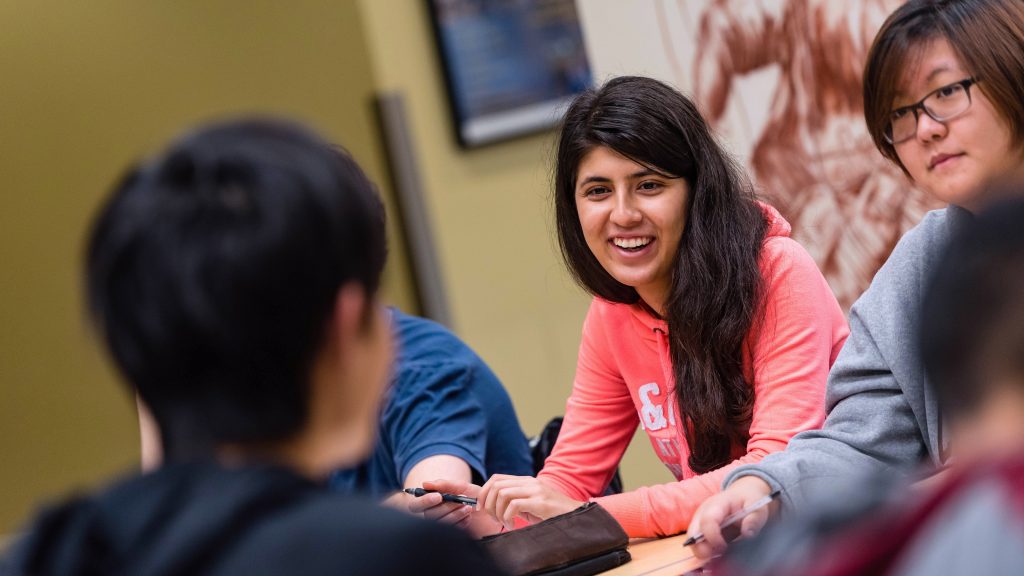



The Arts One program is pleased to offer the annual Dr. Yosef Work Award to current students in the program. The award—valued at $5,000—is awarded to students who demonstrate academic excellence, and a broad understanding of and commitment to social responsibilities. The award is made possible by a generous gift from Dr. Yosef Wosk, alumnus of the first Arts One cohort in 1967.
We are excited to announce that the winners of this year’s Wosk Award are Lena Yang and Valentine Baretta! In these interviews, Lena and Valentine reflect on their time in Arts One, highlighting the texts that speak to them, and bringing what they have learned from Arts One into conversation with their broader commitments to social responsibility.

Lena Yang is a second-year student in the Faculty of Arts at the University of British Columbia. Her academic interests include political philosophy, history, and international relations. As a long time lover of reading and dialogue, she deeply enjoyed her time in Arts One. Outside the classroom, she enjoys volunteering and fine art.
What attracted you to the Arts One program?
Going into first year was daunting. As a new student, you’re acutely aware of how much you don’t know, so every decision feels like a gamble—but I’m so glad mine landed on Arts One. When I first discovered the program, I was immediately drawn to two things. First was the appeal of studying history, philosophy, and English—all subjects I’m passionate about—without the hassle of piecing together separate courses to reach the same goal. Second was the reading list which was both exciting and intimidating! Only later did I come to appreciate the deep intentionality behind each chosen text and how they built upon one another, but even then, I was intrigued by the chance to finally read authors such as Nietzsche, Homer, and Freud—history-changing thinkers I’d heard about for years but had never read firsthand. Arts One gave me the opportunity to engage deeply with these writers, developing my own ideas and conclusions while learning from my peers’ perspectives as well. The program’s unconventional structure relies on indirect learning through the booklist itself and the constant writing process, which helped refine my skills and absorb knowledge firsthand. Through the readings alone, we moved from Ancient Greece to the 21st century, witnessing key moments through the writers themselves—an experience enriched by our weekly lectures. This format sharpened my critical thinking, essay writing, and time management in ways that continue to serve me well beyond the program.
I understand that you have an essay in this year’s issue of the Arts One Student journal on Ursula K. Le Guin’s The Dispossessed. Could you tell us a bit about how this particular text spoke to you?
I’m a fiction reader in my free time, so it’s no surprise that I loved The Dispossessed for its science-fiction elements and adventure narrative. But beyond the surface, I was deeply fascinated by the theoretical yet realistic contrasts Le Guin presents. A central aspect of the novel is the existence of two worlds: Anarres and Urras. Anarres hosts a revolutionary anarchist society that chose to inhabit a barren moon to escape the capitalist system of its mother planet, Urras. At first, it seems obvious which world represents the “ideal” utopia in contrast to the other’s concealed dystopia. Yet as the story unfolds, Le Guin complicates this binary, revealing that “good” and “bad” are insufficient categories for describing either society—echoing Nietzsche’s critique of moral absolutes in The Genealogy of Morality. This persistent ambiguity reminded me to be cautious of reductionist conclusions, both in literature and in life—a lesson I continue to reflect on and apply today. Wanting to explore this idea further, my capstone paper examined Le Guin’s depictions of power and freedom on Urras and Anarres, arguing that despite attempts to categorize either within modern or postmodern frameworks, both the planets and the author herself occupy an space between such binaries. The Dispossessed engages with questions that feel as relevant now as ever, and I would highly recommend it to anyone interested in how fiction can illuminate complex philosophical and political ideas—or simply to anyone looking for a truly great sci-fi read.
How has a sense of social responsibility shaped your life inside and outside the classroom?
The term social responsibility is an interesting one. Personally, I interpret it as the obligation to contribute positively to one’s community and society. But how big does an action have to be to count as a contribution? Having been involved in many projects tied to social responsibility—some of which have taken me across oceans and led me to develop programs of my own—while also simply growing up within a community where I’ve witnessed both care and injustice, my understanding of this concept has evolved over the years. Things I once dismissed as too small to matter, I now see as meaningful acts of social responsibility. For instance, I recall in elementary school often taking the initiative to help classmates struggling with math once I’d finished my own work. It’s a simple example, but I think it reflects the natural impulse many of us have to do our part—not for recognition, but because it feels right and we know we can. That, to me, is the essence of social responsibility. In a world where kindness and volunteering are increasingly commodified, I’ve come to treasure the quiet acts of care—giving up a bus seat, offering a smile to a new classmate—things that go unnoticed yet still have an important impact in making our communities stronger. This same sense of duty has motivated me over the years to volunteer at my local senior home, create programs to address skill gaps I noticed among students, and spend summers teaching at children’s day camps. I did these things because, like everyone, I have time, skills, and experiences to share—and contributing them meaningfully feels like a responsibility we all share. These experiences have shaped me into someone more attuned to the needs of others and more aware of how I can respond to them. They’ve also shown me that every act—big or small—has the potential to create positive change, and that’s a truth I carry with me both inside and outside the classroom.
Can you reflect on your experience in Arts One over the past year in light of your commitments to social responsibility? Were there particular readings that you think have influenced your trajectory in this regard?
Over the past year in Arts One, I’ve come to understand social responsibility not only as a matter of action, but also as a responsibility of knowledge. Many of our texts pushed me to question what I take for granted and to be mindful of the power that ideas and words hold—for both good and harm. Through readings like Rousseau’s Discourse on Inequality, Nietzsche’s Genealogy of Morality, and Brecht’s Life of Galileo, I was challenged to think critically about how knowledge can both liberate and endanger, reminding me that social responsibility involves not only what we do, but also what we say—or even choose to omit—for the sake of others. These works, along with the experience of being in constant dialogue with my peers in Arts One, encouraged me to reflect on my own intellectual position and the need to balance conviction in my beliefs with care for how they might affect others. I’ve realized that responsibility and accountability are not only reflected in grand actions, but also in the small choices we make every day, especially when both have the power to ultimately uphold or undermine our sense of social responsibility.
What is a piece of encouragement or word of advice you’d give to a new Arts One student?
I know that what turns some people away from the program is the admittedly daunting reading list and the idea of writing twelve papers in one year—but if you’re already in Arts One, you’ve overcome that mental hurdle, so congratulations!
“On a serious note, I’ve learned how important it is to recognize that we’re often far more capable than we think. Don’t let anxiety about not being “enough” or fear of hard work stop you from taking on challenges that will ultimately help you grow into a stronger, more well-rounded student.”
When I first joined Arts One, I made the mistake of reading past students’ capstone papers to see what I was in for. After skimming a few, I felt completely overwhelmed and disheartened—how could I ever write something so sophisticated and polished? What I didn’t realize then was that I was comparing myself, a brand-new freshman, to students who had already completed a full year of growth within the program. My advice would be to take full advantage of the close access you have to your professors in Arts One—something rare and incredibly valuable—and to use your seminars and tutorials to have confusing, deep, and even weird conversations with your peers. A huge part of why my writing improved so much was not just because we wrote often, but because I received regular, detailed feedback from my professor (Joy Dixon—your grading speed is remarkable!) and used it to make each paper a little better than the last. So, my advice is simple: work hard, use your resources, and most importantly, believe in yourself. You’ll be amazed at how much you can grow in just one year.

Valentine is originally from France but grew up in North Vancouver. In her free time, she enjoys reading fiction, watching the same movies again and again, playing the violin with friends, and baking to avoid dealing with stress. She was in Dr. Konoval’s seminar and is pursuing a Bachelor of Arts majoring in International Relations at UBC.
What is one memory that you take from Arts One?
Arts One has been a collection of moments for me, rather than one important moment. I think improving my writing and analytical skills over time as well as building relationships and meeting new people have been the highlight of my time in the Arts One Program. The people in the program are really what makes it shine and they make it worth it to work hard.
I understand that you have an essay in this year’s issue of the Arts One Student journal on Homer’s The Odyssey, where you focus on Homer’s depiction of female characters. Could you tell us more about how you became interested in this particular topic?
Ever since reading Frankenstein by Mary Shelley in my 11th grade English class, I’ve been interested in the representation of women and their voices in literature. Often, women lie in the backdrop of the quests of male heroes, and I’ve made it my mission to uncover the meanings behind their actions and subtle depictions. The Odyssey by Homer was the perfect opportunity for me to explore how female characters were portrayed and the power and influence they have in shaping the hero’s journey. I particularly like the character of Penelope and how she used the limits imposed on her by the patriarchy to exert influence and keep the peace in Ithaca.
How has a sense of social responsibility shaped your life inside and outside the classroom?
“In A Discourse on Inequality, Rousseau argues that compassion is a natural virtue of humans. Though I am not inclined to agree with all of Rousseau’s ideas, this notion is, to me, a comforting one. I believe natural compassion is what drives us to engage in social responsibility and I think everyone can involve themselves in their communities somehow, whether their actions be big or small.”
Being involved in my community has helped me become more outgoing and shaped me into a leader who values everyone’s voice and contributions, which I have brought into my participation in the Arts One program.
Can you reflect on your experience in Arts One over the past year in light of your commitments to social responsibility? Were there particular readings that you think have influenced your trajectory in this regard?
Arts One has brought me connections and community at UBC, which I have found to be invaluable. The small discussions we had allowed for thoughtful discourse on a variety of topics, including social responsibility as it pertains to our texts. A few notable texts we have read related to social responsibility include The Genealogy of Morality by Friedrich Nietzsche, Papers Please, and The Life of Galileo by Bertolt Brecht, which all approach the topic from different perspectives.
What are your top 3 favourite texts from Arts One and why?
I loved reading The Dispossessed by Ursula K. Le Guin because it was such an interesting science fiction novel with a unique structure and approach to commentary on the real world. I also really enjoyed All the Pretty Horses by Cormac McCarthy because of its intricacies and hidden meanings. Lastly, I loved studying The Country Under My Skin by Gioconda Belli, which was so inspiring and eye-opening to me, even though I haven’t always been a fan of memoirs. Overall, Arts One exposed me to a wide variety of texts, opened my mind to new perspectives, and enriched my understanding of literature.